The middle section of Surah Yasin changes method. The opening argued. The town story illustrated. Verses 33 to 50 point at things the audience can see for themselves and ask them to draw the obvious conclusion. This is the part of the surah most often quoted in discussions of the natural world, and it is worth reading as a single argument rather than a list of separate observations.
The dead earth as the opening sign
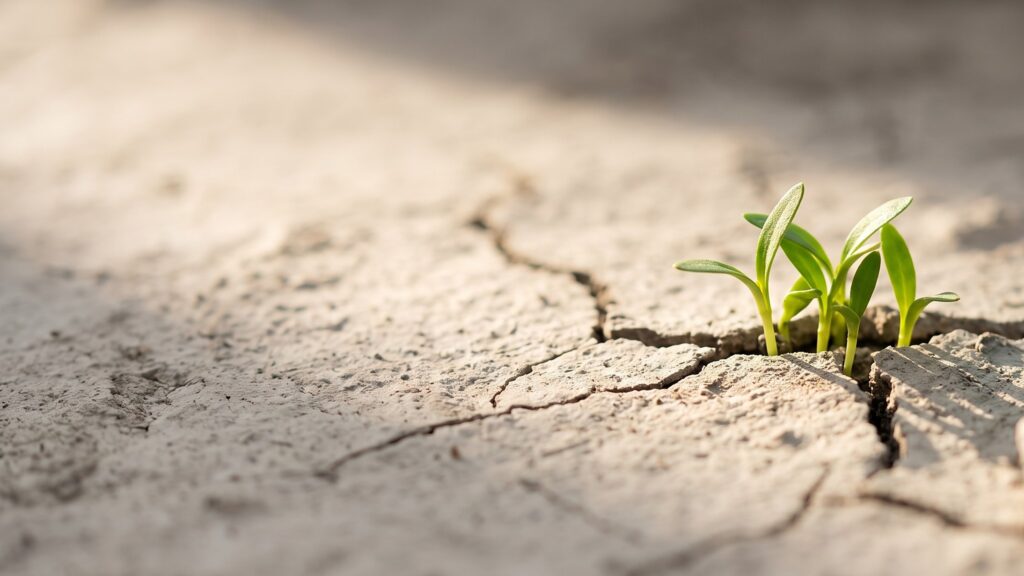
The section begins with land that was dead, which is then revived and made to produce grain that people eat. Gardens of date palms and grapevines follow, with springs made to flow through them, so that people may eat of its fruit, which their own hands did not make.
Two things are being established. First, revival after death is not a strange concept being introduced for the first time; it is the ordinary operation of the world, observable every year. Second, the produce is not the work of human hands. Effort is involved, but the process that turns a seed into a date palm is not something anyone designed or controls.
The passage then widens to the pairs created in what the earth grows, in people themselves, and in things they do not know. The last phrase is doing real work. The argument does not claim that everything has been catalogued. It claims that the pattern holds beyond what is currently visible.
Night stripped from day
The second sign describes the day being drawn out of the night so that people are left in darkness. The image is of removal rather than arrival. Night is not presented as something that comes; day is presented as something withdrawn.
This inversion is deliberate and it recurs in Arabic usage. It places light in the position of the thing granted and darkness in the position of the default. The rhetorical effect is to make a daily event feel like a daily withdrawal of something given.
The sun and moon, each in an orbit
The sun runs to a resting place appointed for it. The moon is given stations, until it returns like an old dried date stalk, the thin curved branch that carries the fruit. Then comes the statement that the sun is not permitted to overtake the moon, nor does the night outstrip the day, and each floats in an orbit.
Some modern writing treats these verses as a scientific announcement. That reading tends to prove less than it promises and it is not how the passage functions. The argument here is about order and limit. Each body has a course it does not leave and a boundary it does not cross. What the verses assert is regulation, and regulation is what the surah wants the audience to notice, because the section closes by asking what would happen if that regulation were withdrawn.
The comparison of the waning crescent to a dried date stalk is worth pausing on separately. It is a farmer’s image, immediate to the original audience, and it captures both the shape and the thinness with one word.
The laden ship
The fourth sign is that the ancestors of the audience were carried in the laden ship, and that similar things have been made for them to ride. The verses continue: if it were willed, they could be drowned, with no one to answer their cry and no rescue, except as a mercy and an enjoyment for a time.
This is the most pointed of the four. A ship is a human construction, and the people being addressed built ships. The verse does not deny the engineering. It observes that the sea holds the ship up, and that nothing in the ship’s design gives its passengers a claim on the sea’s cooperation. The reference to similar things made for them to ride has been read by later commentators as extending to transport not yet invented, which the wording permits without requiring.
The turn at verse 45
Having laid out the signs, the passage turns. The audience is told to be conscious of what lies before them and behind them, so that they might receive mercy, and the response is recorded: no sign comes to them from the signs of their Lord without their turning away from it.
Then the sharpest exchange in the section. When told to spend from what Allah has provided, the disbelievers answer the believers by asking whether they should feed someone whom Allah could have fed if He willed.
The argument is a real one and it still circulates. If provision is decreed, why is giving required? The Quran records the objection without answering it discursively, calling it clear error and moving on. The answer is structural: the objection uses divine decree to excuse the objector from acting, which is the one use of the concept the Quran never permits. The person raising it is not reasoning about provision. They are declining to give.
The section closes on the blast
The final verses return to the theme of the town story. The disbelievers ask when the promise will be fulfilled, and the answer is that they await only a single blast that will seize them while they are still disputing, so suddenly that they cannot make a bequest or return to their families.
Read alongside verses 29 and 31, this makes the surah’s structure explicit. The town was ended by one cry. The world will end by one blast. The scale is different and the mechanism is identical.
Continue with the tafsir of verses 51 to 83, or read the full surah.
Frequently asked questions
Do these verses describe modern astronomy?
They describe order, limit and orbit in language their first audience understood. Reading precise modern models into them requires assumptions the text does not supply, and claims of that kind tend to be revised whenever the science is revised. The argument the verses actually make does not depend on it.
What is the resting place of the sun?
The Arabic term has been read as a fixed appointed limit in time, as a destination, and as a place of rest. Classical commentators differed. All three readings support the same point about an appointed boundary.
Why is the objection about feeding the poor left unanswered?
The Quran calls it manifest error rather than debating it. The passage treats it as an excuse rather than a question. See the benefits of Surah Yasin for how the surah’s themes connect to practice.